
Abbreviation: DAMPCEL
Project No. 44PTE/2020
Project Director, Dr. Eng. Veronica Achim
The detailed technical report can be accessed at https://uefiscdi.wixsite.com/dampcel
The published results can be accessed at https://uefiscdi.wixsite.com/dampcel/rezultate
PRESENTATION
PN-III-P2-2.1-PTE-2019-0432
The project aims to implement innovative damping components, made of porous materials impregnated with nanofluids within the structure of protective helmets. The mechanism underlying the proposed solution is known as Elasto-Poro-Hydrodynamic Lubrication (XPHD) and has been highlighted since 2000 within UPB. The damping effect comes from the dissipation of impact energy through viscous friction of the fluid expelled through the porous material upon impact compression. The stronger the impact, the more pronounced the compression, the lower the porosity of the material, increasing the flow resistance and the generated pressure.
Development at the experimental model level (damping cell) took place in the previous period within a PN-II-PT-PCCA project in which two of the current partners of the proposal collaborated (UPB and STIMPEX S.A.).
The testing of the shock absorber cells was carried out in different configurations and energy levels both on the UPB stands and on a pneumatic propulsion installation from the ATM equipment. The results showed that the impact force is reduced by half when the shock absorber cells were used.
The current project provides for two test stages (TRL 5 and TRL 6). In the first stage, helmet sectors that incorporate a system of interconnected shock absorber capsules will be manufactured and tested. These tests aim to establish an optimal structure of the shock absorber elements. The tests in the 2nd stage will be carried out according to the STANAG 2920 standard on the helmet developed at the level of a small-series industrial prototype. The prototype will be subjected to an operational test program, through which the functionality will be demonstrated under relevant conditions. The aim is to develop a new manufacturing technology, which will involve the simultaneous processing of several shock absorber elements on specialized work stands for operations, in order to increase labor productivity.
OBJECTIVES
In order to achieve the purpose proposed within the project, the following objectives were established:
Manufacture of the product protective helmet equipped with cushioning components made of porous materials impregnated with nanofluids as a small-series industrial prototype by SC STIMPEX SA, based on the technology developed by UPB;
Transfer of technology and know-how regarding shock absorption and dissipation components to SC STIMPEX SA, which thus becomes the first economic agent in Romania that can offer this type of protective helmet, becoming competitive on a global scale;
Development and maintenance of a sustainable partnership between STIMPEX SA, UPB and ATM, based on the complementary concerns of the three institutions in the field of ballistic protection, subsequently offering the possibility of capitalizing on other R&D results of UPB and ATM through technological transfer and introduction into manufacturing;
Orienting part of the income of the economic agent STIMPEX SA towards research, by financing and assimilating some R&D products of UPB and ATM, for the purpose of their commercial exploitation on the domestic and international market.
Project stages and budget value:
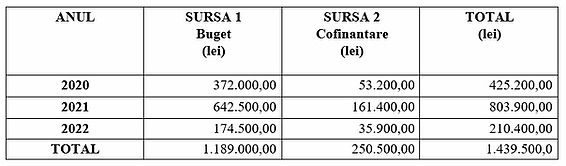
RESULTS OF STAGE 1
- Technical documentation for the realization of flat structures made of Kevlar-based composites necessary for carrying out the tests
- Technical documentation for the realization of 3 variants of SAC cells
- Technical documentation for the realization of structures with curved surfaces to simulate the shape of the helmets during the tests
- Technical documentation for the parts necessary for the manufacture of the sabot/projectile assembly equipped with an accelerometer
Activities – stage II
Activity II.1 Performing experiments on a relevant number of models
Activity II.2 Processing experimental data and modeling the observed phenomena, comparing with similar results, evaluating limits and improvement solutions (capsule dimensions and positioning, fixing method)
Activity II.3 Establishing the manufacturing technology for flexible capsule-type damping elements
Activity II.4 Design and execution of the small-series industrial prototype for the protective helmet incorporating a system of interconnected damping capsules
Activity II.5 Design, execution and instrumentation of an experimental device for attaching headphones (“head rig”) according to applicable standards
Activity II.6 Conducting preliminary experiments on headphones
Activity II.7 Dissemination of preliminary results
Results – stage II
Results:
Ballistic system with compressed air
Technical documentation for the development of 3 variants of SAC cells
Planar structures made of Kevlar-based composites necessary for testing
Curved surface structures for simulating the shape of the helmets during testing
Project website
Scientific report
Stage II period: January 2021 – December 2021
Execution stage 2022
Summary
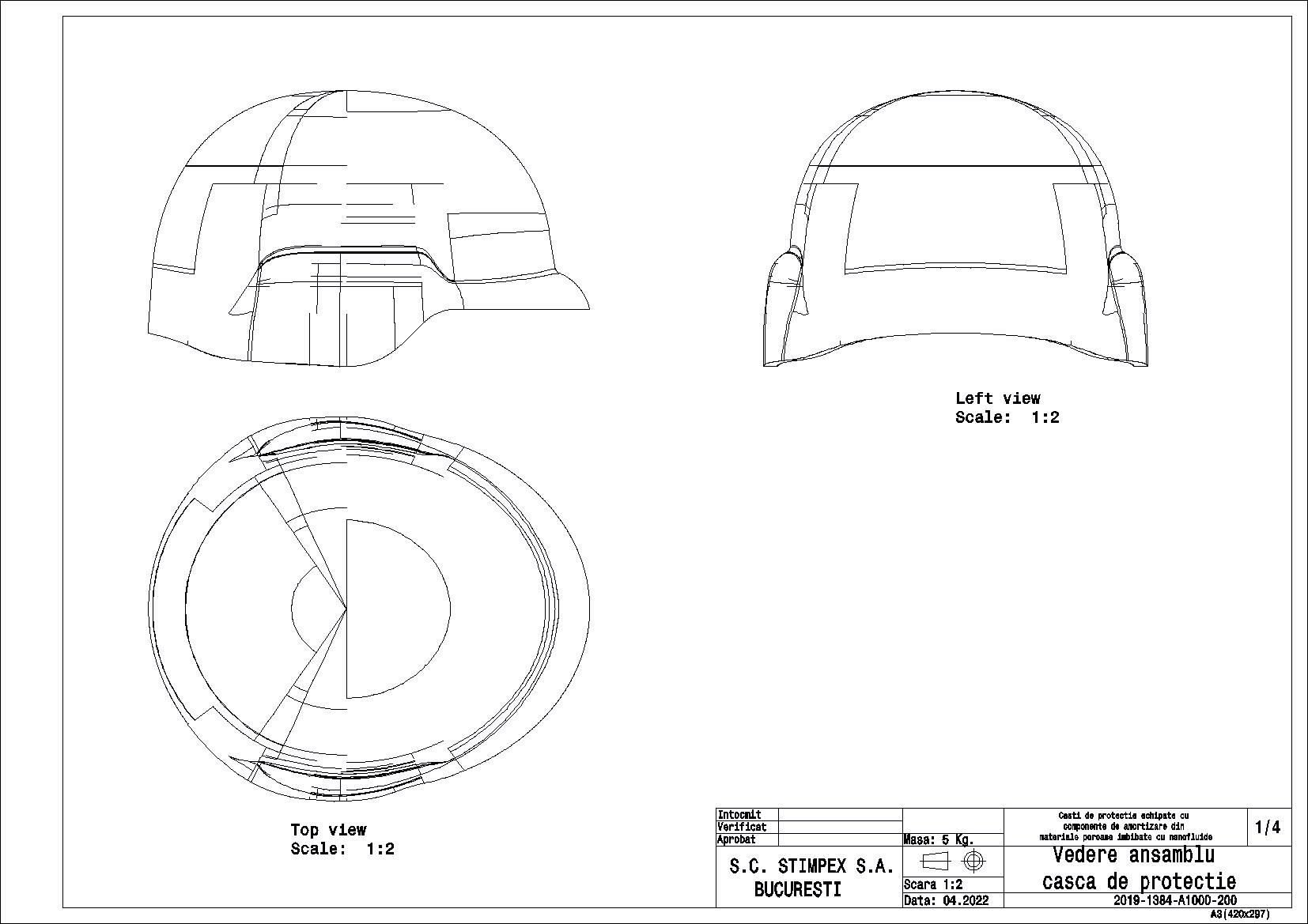
The 3rd final stage of the project presents the achievement of the final objective of manufacturing the product protective helmet equipped with damping components made of porous materials soaked with nanofluids as a small-series industrial prototype. In support of this goal, experimental activities were carried out to test the helmet under bullet impact conditions and with cylindrical projectiles on a gas cannon. The technological manufacturing solutions based on gluing the encapsulation membrane using high-frequency currents were improved along with the other technological stages of filling and preparing the porous cushions. Testing on the gas cannon allowed a better understanding of the damping mechanism under controlled laboratory conditions by evaluating the impact force as a function of the projectile energy. Testing in the polygon allowed only a qualitative assessment of the damping capacity by measuring the deformation produced by a cal. bullet. 7.62mm fired from a “TT” type pistol upon impact with a classic helmet (these measurements were considered reference) and upon impact with a helmet with shock absorbers.

 English
  Română