
ADVANCED INTEGRATED PROTECTIVE CLOTHING SYSTEM FOR EMERGENCY INTERVENTIONS – APPES
GENERAL DATA
Funding institution: Executive Unit for Financing Higher Education, Research, Development and Innovation (UEFISCDI)
Funding program: National Plan IV (PN IV),
Program 5.7 – Partnership for Innovation
Subprogram 5.7.1 – Partnerships for competitiveness
Funding instrument: Transfer to the economic operator PTE – 2024
Project code: PN-IV-P7-7.1-PTE-2024-0215
Contract no. 29 PTE from 08/01/2025
Project duration: 24 months: 08.01.2025 – 31.12.2026
Project budget: 1,890,000 Lei (of which 390,000 Lei co-financing)
RESEARCH TEAM
Coordinator: SC STIMPEX SA
General Director: Eng. Marcel Istrate
Project Director: Dr.eng. Catalin Enescu
Partner: NATIONAL INSTITUTE FOR RESEARCH AND DEVELOPMENT FOR TEXTILES AND LEATHER
General Director: Dr. Eng. Alexandra Gabriela Ene
Project Manager: Eng. Doina Toma
PROJECT PURPOSE
The APPES project (“Advanced Integrated Protective Clothing System for Emergency Response”) aims to develop equipment systems incorporating multiple protective properties, designed for rescue teams and emergency services/organizations working in complex and dangerous conditions, in everyday emergency operations.
PROJECT OBJECTIVES
The general objective of this project is to develop modular multi-risk protective clothing systems and monitoring systems, designed to be integrated, in order to increase the operational and response capacity in emergency response missions.
The specific objectives for achieving the general objective are:
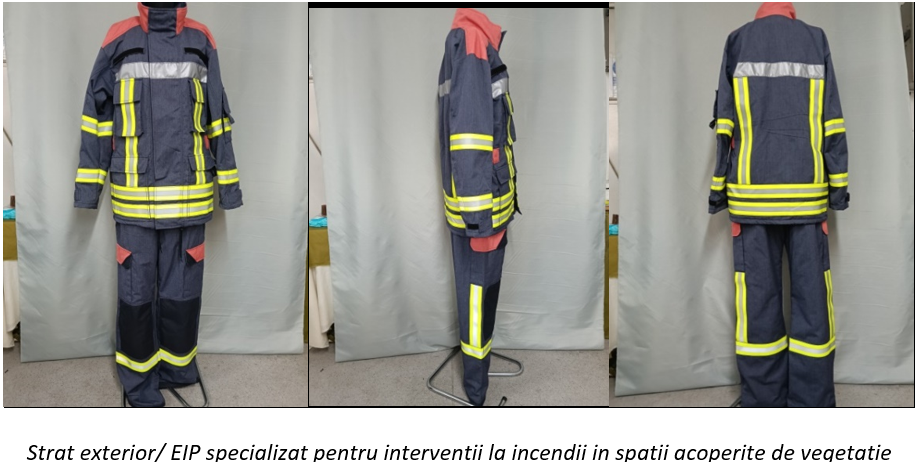
OS1: Design and manufacture of modular protective clothing layers for emergency response actions: a) inner layer (undergarment equipment), close to the skin: which ensures the moisture absorption and transfer function integrated with the thermal protection function and the physiological monitoring function; b) base layer (Service uniform): which ensures limited protection against the risks with the highest probability of occurrence in the event of an unpredictable response action (e.g. flame and heat, blood-borne pathogens, cuts/stings, etc.); c) layers specific to the intervention mission that ensure protection against specific risks (e.g. fires, hazardous materials, firearms, etc.) d) layers of protection against environmental conditions: that ensure protection against environmental factors associated with the intervention action (e.g. extreme temperatures, drafts, inclement weather, etc.) as well as testing-validation under laboratory conditions, through specific tests.
OS2: Design and production of prototypes of protective clothing systems for intervention actions in emergency situations that ensure: a) safety function – limited protection against heat and/or fire by using for the base layer – Service uniform of woven textile materials made of high-performance and/or functional fibers/yarns; b) ensure safety functions: protection against heat and fire/or protection against environmental factors – by integrating, in the clothing system, over the service uniform, modular layers specific to the intervention mission; c) ensures the function of moisture absorption and transfer integrated or not with the thermal protection function (increased thermal transfer capacity) integrated or not with the autoimmunization function (resistance to biological agent penetration) – by using for the inner layer, in contact with the skin – the undergarment equipment – woven and/or knitted textile materials made of high-performance and/or functional fibers, with high moisture transport capacity, and/or antistatic and/or with biocidal properties; d) ensures the monitoring and communication function by integrating into the clothing system specific sensors for the physiological monitoring of emergency workers and the monitoring of environmental conditions during intervention actions.
OS3: Validation through testing in real conditions of use of prototypes of protective clothing systems in modular structure intended for intervention actions in emergency situations.
STAGE 1: Design of modular layers of protective clothing for emergency workers. Creation of modular protective clothing layers for emergency workers
1.1 Technical substantiation of solutions for the creation of protective clothing systems for emergency workers
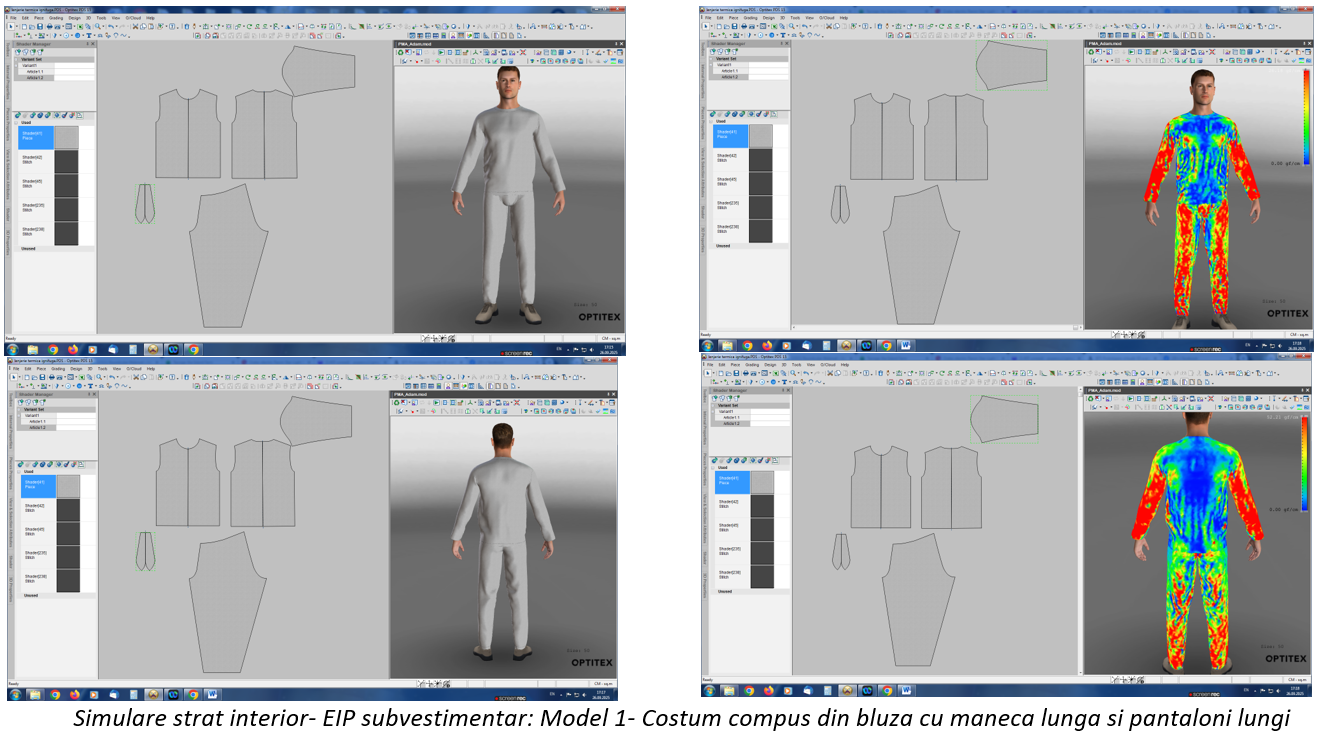
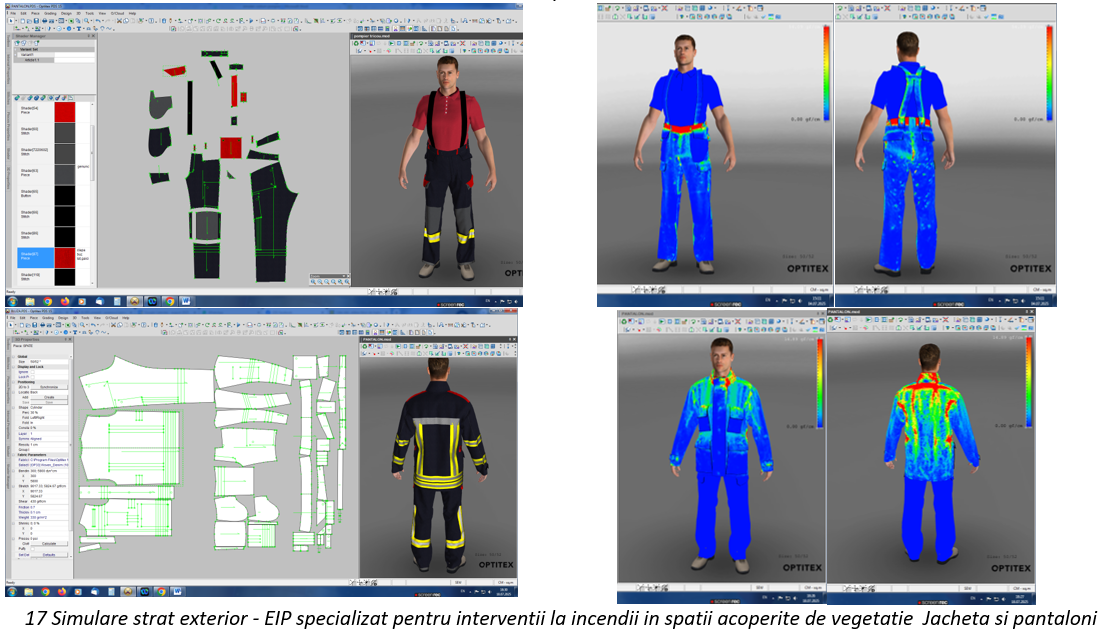
1.2 Structural-technological design of modular protective clothing layers for emergency workers
1.3 Design of multifunctional textile structures intended for the creation of protective clothing for emergency workers
1.4 Creation of multifunctional textile structures intended for protective clothing for emergency workers
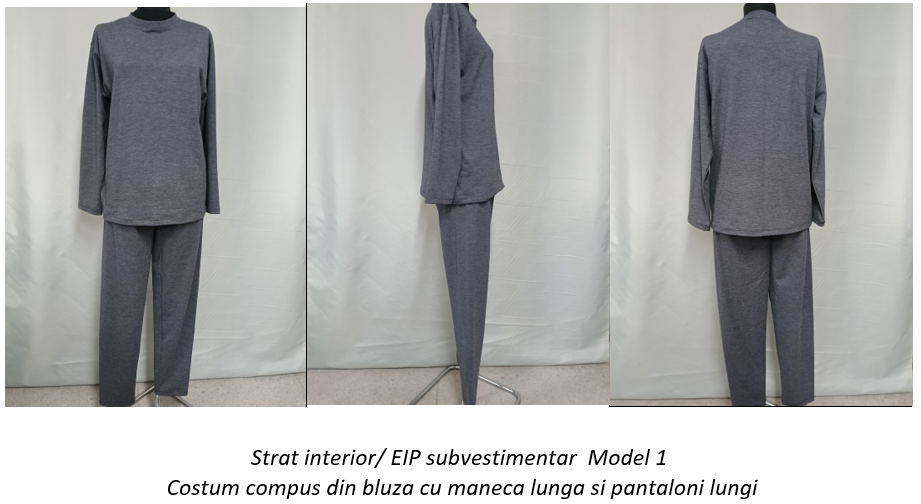
1.5 Creation of modular protective clothing layers for emergency workers (partial)
1.6 Dissemination of results. Creation of web page
Results:
D1. Report on operational capabilities, performance and design requirements applicable to protective clothing systems for emergency workers
D2. Design report of modular protective clothing layers for emergency workers
D3. Report – design of multifunctional textile structures
D4. Multifunctional textile structures intended for protective clothing for emergency workers
D5. Modular protective clothing layers for emergency workers (partial)
D6. Technical, scientific and financial report stage 1, scientific article, participation in scientific conferences, creation of a web page

 English
  Română