GENERAL DATA
Funding institution: Executive Unit for Financing Higher Education, Research, Development and Innovation, CNCS-UEFISCDI
Funding program: National Plan III (PN III),
Program 2: Increasing the competitiveness of the Romanian economy through research, development and innovation
Subprogram 2.1. Competitiveness through research, development and innovation
Financing instrument: Transfer to the economic operator PTE-2019
Project code: PN-III-P2-2.1-PTE-2019-0241
Contract no. 9PTE of 18/05/2020
Project duration: 24 months: 18.05.2020 – 17.05.2022
Project budget: 1,488,100.00 Lei (of which 299,100.00 Lei co-financing)
RESEARCH TEAM
Coordinator: SC STIMPEX SA
General Director: Eng. Marcel Istrate
Project Director: Dr.eng. Vasile Șomoghi
Partner: NATIONAL RESEARCH – DEVELOPMENT INSTITUTE FOR MATERIALS PHYSICS BUCHAREST RA
General Director: Dr. Ionuț Marius Enculescu
Project Manager: Dr. Ștefan Neațu
PROJECT PURPOSE
The DETOXSENS project (“Hybrid catalytic/photocatalytic system for decontamination of sensitive equipment”) aims to develop innovative industrial technologies for the decontamination of sensitive equipment (electronic equipment control panels, computers, sensors and electro-optical systems, etc.), military and/or civilian, based on hybrid catalytic/photocatalytic systems for the decontamination of real chemical warfare agents.
PROJECT OBJECTIVES
The general objective of this project is to develop devices based on hybrid catalytic/photocatalytic systems effective in the decontamination of chemical warfare agents and their simulants, which must combine the following properties: (i) decontamination must occur rapidly using photocatalytic powder suspensions and in the absence of sacrificial chemicals, (ii) decontamination must take place under ambient conditions, by transforming chemical warfare agents and their simulants into non-toxic or much less toxic reaction products, and (iii) these systems must be environmentally friendly, non-corrosive, and their synthesis must be able to be carried out in large quantities through a simple process using the cheapest possible raw materials. For the case of chemical warfare agents, the presence of an optimal environment that facilitates the desorption/dissolution (decontamination) of the chemical agent from the contaminated surface is very important.
The project presents a series of specific objectives, exploitable in specific applications of a military and/or civilian nature by specialized structures of the Ministry of National Defense and the National Defense System:
- O1. Large-scale preparation of the hybrid catalytic/photocatalytic component of the decontamination system;
- O2. Transfer of the manufacturing process of the decontamination product based on hybrid catalytic/photocatalytic systems to the economic operator S.C. Stimpex S.A.;
- O3. Introduction of the devices developed within the project into the army’s equipment;
- O4. Large-scale manufacturing of these devices so as to ensure demand at the level of the specialized structures of the Ministry of National Defense and other operational structures of the National Defense System.
PROJECT IMPLEMENTATION STAGES:
STAGE I – 2020 – Development of DETOXSENS industrial-level manufacturing technology
RESULTS OBTAINED IN STAGE I
Activities:
A1.1. Analysis of the manufacturing technology of the experimental model and establishment of requirements for the transition to the industrial level. Choice of the optimal composition for the decontamination suspension.
A1.2. Development of the DETOXSENS industrial prototype manufacturing specification and establishment of the necessary machinery and equipment for the industrial pilot plant. Establishment of the technological flow.
A1.3. Establishment of constructive variants for the device, depending on its capacity (200 and 1000 mL).
A1.4. Redesign of the device according to the requirements resulting from the completion of previous activities and the industrial prototype manufacturing specification.
A1.5. Establishment of relevant operating conditions for the device.
A1.6. Dissemination of research results.
Deliverables resulting from stage I
D1 – Technology requirement report I/1.1
D2 – Industrial prototype manufacturing specification I/1.2
D3 – Industrial prototype execution documentation I/1.3
D4 – Relevant operating conditions document I/1.4
All activities planned for stage I have been fully completed.
STAGE II – 2021 – Execution of the DETOXSENS industrial prototype batch
According to the DETOXSENS project implementation plan, within Stage 2, the CO coordinator (SC STIMPEX SA) and the P1 partner (National Institute for Research and Development for Materials Physics) carried out the following research sub-activities:
A2.1. Creation of the pilot manufacturing facility for the industrial prototype.
A2.2. Preparation of technical procedures for the production of the industrial prototype.
A2.3. Preparation of the material base for the execution of the prototype batch. Conducting conformity analyses of raw materials for the industrial prototype batch.
A2.4. Technological tests for the pilot manufacturing facility. Execution of an industrial pre-prototype batch.
A2.5. Relevant tests with the pre-prototype batch and analysis of the results. Functional and constructive optimization of the device based on the test results.
A2.6. Updating the execution documentation and manufacturing specification.
A2.7. Execution of the DETOXSENS industrial prototype batch – 10 pcs. for each chosen construction variant..
A2.8. Dissemination of research results.
Following the research activities in Stage II, the following deliverables resulted, provided in the project implementation plan, in accordance with the funding request:
- D5 Pilot plant for industrial prototype manufacturing
- D6 Technical operating procedures for the pilot plant no. 702/29.11.2021
- D7 Raw material conformity test report, prepared by P1
- D8 Small series pre-industrial prototype
- D9 Industrial prototype execution documentation v.1 no. 703/29.11.2021
- D10 Industrial prototype manufacturing specification v.1 no. 704/29.11.2021
- D11 DETOXSENS industrial prototype batch
Following the activities related to stage II in 2021, the pilot plant for the production of the industrial prototype, 3 pre-industrial prototype batches were built, the updated technical manufacturing specification and execution documentation for DETOXSENS were developed, valid at the industrial prototype level, and the industrial prototype batch was manufactured in the 200ml and 650ml variants – 10 pcs. each from each capacity.
Industrial prototype manufacturing pilot plant
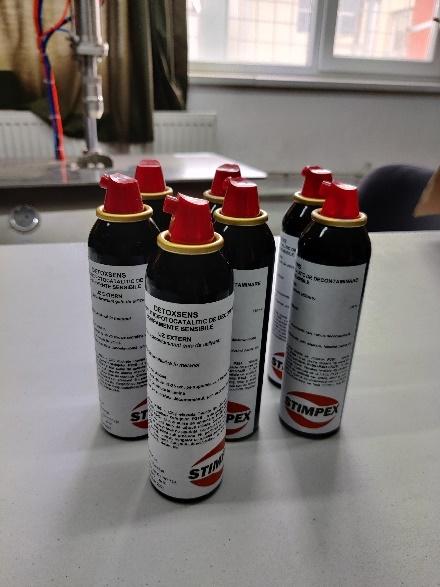
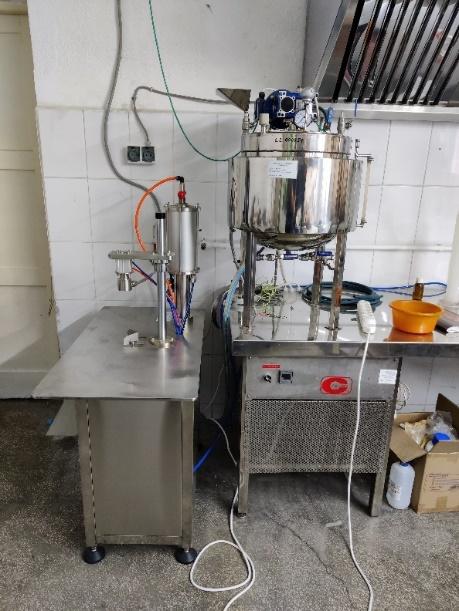
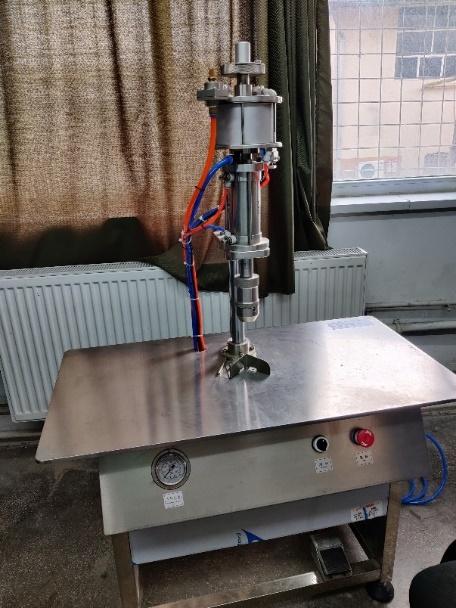
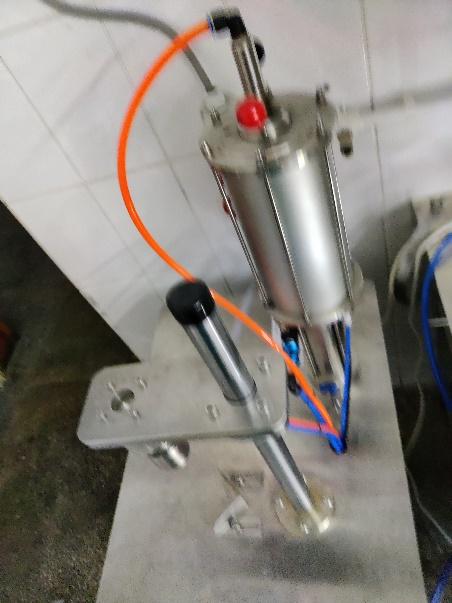
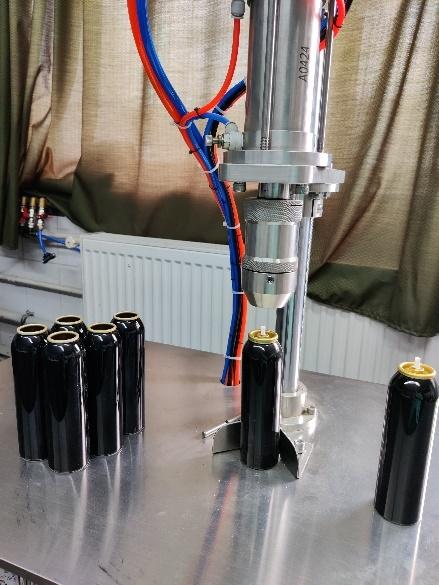
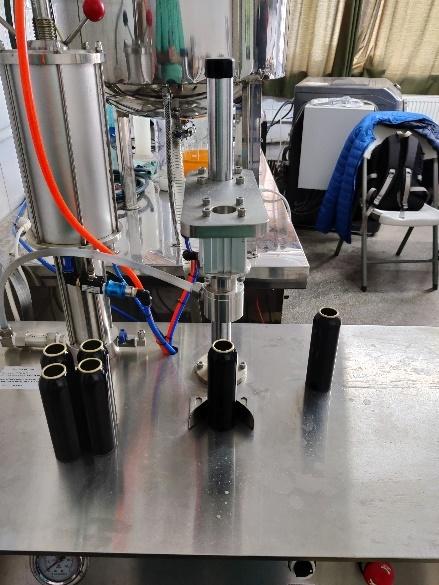
Manufacturing of industrial pre-prototype batches
Considering the results obtained during this stage of the project, as well as the degree of implementation achieved, we can assess that the research activities carried out have fully satisfied the objectives proposed for Stage II.
STAGE III – 2022 – Testing and evaluation of the DETOXSENS industrial prototype batch
According to the DETOXSENS project implementation plan, within Stage 3, the CO coordinator (SC STIMPEX SA) and the P1 partner (National Institute for Research and Development for Materials Physics) carried out the following sub-activities:
Activity 3.1. Execution of the DETOXSENS industrial prototype batch – 40 pcs. for each chosen construction variant
Activity 3.2. Preparation of the Test Plan – evaluation of the DETOXSENS industrial prototype batch
Activity 3.3. Testing the DETOXSENS industrial prototype batch
Activity 3.4. Preparation of the Test Report – evaluation of the DETOXSENS
Activity 3.5. Updating industrial manufacturing technology and manufacturing specification
Activity 3.6 – Dissemination of the results of the DETOXSENS industrial prototype testing in specialized journals and conferences.
Activity 3.7 – Organizing a workshop to present the product with the participation of decision-makers from the Ministry of Education, Science and Technology and other interested structures.
The research activities in Phase III resulted in the following deliverables, as provided for in the project implementation plan, in accordance with the funding request:
– D11 DETOXSENS industrial prototype batch
– D12 Test plan – industrial prototype batch evaluation (no.308/13.05.2022)
– D13 Test report – industrial prototype batch evaluation (no.309/13.05.2022)
– D14 DETOXSENS manufacturing documentation (no.310/13.05.2022)
– D15 Updated manufacturing specification (no.311/13.05.2022)
Following the activities related to stage III in 2022, the industrial prototype batch was produced, the updated manufacturing technical specification and execution documentation for DETOXSENS were developed, valid at the industrial prototype level, and the industrial prototype batch was tested in the 200 ml and 670 ml variants. The test results confirmed the exceptional efficiency of decontamination and created the premises for the development, testing and approval of a sensitive equipment decontamination kit, which will become part of the army’s equipment.
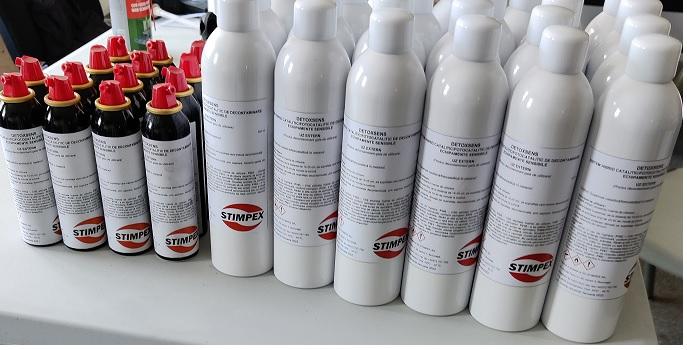
DETOXSENS industrial prototype batch
| Decontamination efficiency | Residual toxicity | |
| Soman | % | Ppm |
| GD_ref_800 ppm | 0.00 | 800.00 |
| GD_2min | 99.58 | 3.39 |
| GD_10min | 99.62 | 3.05 |
| Paraoxon | ||
| Pox_ref_800 ppm | 0.00 | 800.00 |
| Pox_2min | 99.46 | 4.28 |
| Pox_10min | 99.61 | 3.12 |
| Yperite | ||
| HD_ref_800 ppm | 0.00 | 800.00 |
| HD_120 min | 88.86 | 89.10 |
Results of DETOXSENS testing on real chemical warfare agents
The project results were presented at a workshop, organized by the project coordinator on May 10, 2022. The workshop was attended by decision-makers from the Ministry of Defense, the Ministry of Interior and other structures.
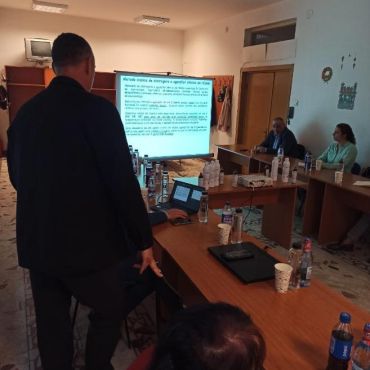
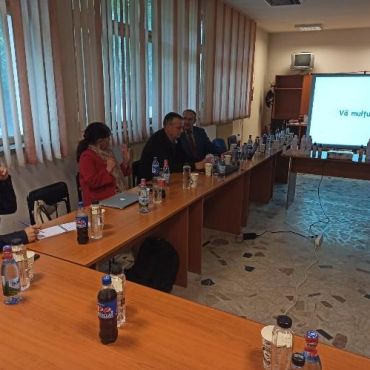
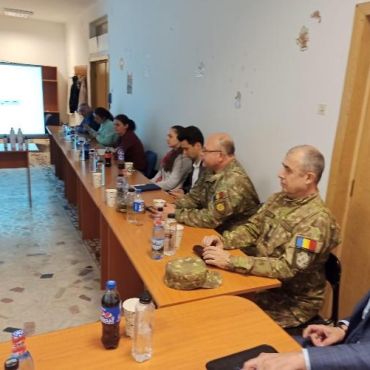
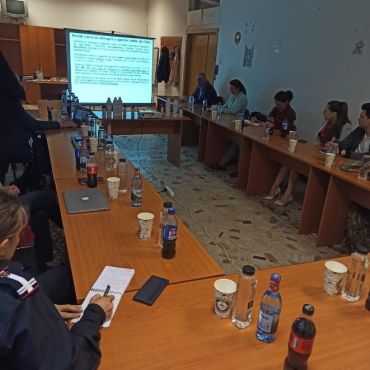
Images from the workshop
Following the discussions, the development directions and subsequent activities were established to define the technical characteristics of the future sensitive equipment decontamination kit and the actions to be taken for the product approval and its introduction into the army’s equipment.
CONCLUSIONS
All the objectives of the DETOXSENS project were achieved 100% and the most significant result derived from the project is the obtaining of the industrial prototype using the complex hybrid system of lanthanum-Au/TiO2. The future perspectives opened by the DETOXSENS project include: a) Integration of DETOXSENS pressure vessels into a sensitive equipment decontamination kit that would also include the necessary instruments for decontamination; b) Testing of the industrial prototype decontamination kit, with the participation of the Research and Innovation Center for CBRN Defense and Ecology, its approval with the General Directorate for Armaments and its introduction into the Army’s equipment; c) Transition to mass production and ensuring the necessary supplies for the Romanian Army, other entities in the National Defense System and for export.
SUMMARY
The catalytic/photocatalytic system for decontamination of sensitive equipment is a device that ensures the rapid destruction of chemical warfare agents deposited on sensitive equipment (electronic, optical equipment, the interior of combat vehicles, etc.), but also on individual combat equipment and on the protective equipment of the military. The product will be delivered in spray-type carrier gas containers of two capacities (200 ml and 670 ml), and upon request it can be delivered in other capacities. The product is intended for the following customers:
- Ministry of National Defense – for decontamination units and subunits, but it will also be able to equip military vehicles and equipment that have systems that can be destroyed in conventional decontamination operations. The product can be used by any military, after minimal training.
- The Ministry of Internal Affairs, through the Emergency Situations Inspectorates, which have mobile CBRN intervention teams at the level of each county, disaster intervention teams, military personnel who can intervene in CBRN contaminated environments.
- The pyrotechnic intervention teams within the SRI, SPP and the mobile intervention teams of the Environmental Guard are also potential users.
Unlike other sensitive equipment decontamination systems on the market, which only ensure a physical removal of contaminant agents, without their destruction, DETOXSENS allows their total destruction, simultaneously with the removal by adsorption of decontamination products and contaminant residues.

 English
  Română